
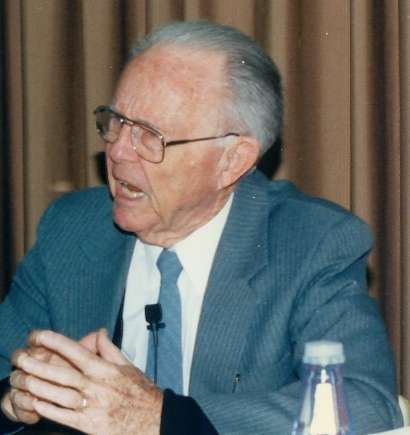
In the world of translation and linguistics, some names stand as giants, having shaped how we understand communication across cultures. One such visionary was Eugene Nida, the father of dynamic equivalence translation. Let’s explore the life and legacy of the man who made the Bible accessible to hundreds of millions.
Born Date, City, Country
Eugene Albert Nida was born on November 11, 1914, in Oklahoma City, Oklahoma, United States.
Early Life: The Making of a Linguist
Eugene Nida’s fascination with language began early. He grew up in a devout Christian family, but his intellectual curiosity stretched far beyond the pulpit. He was a true prodigy:
-
Academic Brilliance: He graduated summa cum laude from the University of California, Los Angeles (UCLA) at just 20 years old.
-
A Passion for Languages: His thirst for linguistic knowledge was insatiable. He went on to earn a Master’s degree in Greek and a Ph.D. in Linguistics from the University of Michigan. It’s said he could already recite the entire New Testament in Greek from memory by his early twenties.
-
A Calling Found: In 1943, Eugene Nida began his lifelong association with the American Bible Society (ABS). It was here he found his mission: to break down the barriers of language and make scripture understandable to every person, in their own “heart language.”
His Books: A Foundation for Modern Translation
Eugene Nida was a prolific writer, and his books have become foundational texts in the fields of translation theory, linguistics, and missiology. His work moved translation from a literal, word-for-word exercise to a meaningful, thought-for-thought communication.
Here are some of his most influential books:
-
Toward a Science of Translating (1964)
This was a groundbreaking work where Eugene Nida began to systematically lay out his theories. He argued that translation must be based on modern linguistic science and cultural anthropology, moving beyond a simple “literal vs. free” debate. -
The Theory and Practice of Translation (1969, with Charles R. Taber)
This is perhaps his most famous and practical work. It’s here that he fully developed the concept of “dynamic equivalence” (later known as “functional equivalence”). The core idea is that the best translation reproduces the meaning and effect of the original text on the modern reader, rather than being chained to its grammatical form. -
Customs and Cultures: Anthropology for Christian Missions (1954)
This book showcases Nida’s deep understanding that language is inseparable from culture. He argued that to translate effectively, one must understand the cultural context of both the source and target audiences. -
Fascinated by Languages (2003)
A more personal later work, this book is a delightful memoir where Nida recounts his experiences with the countless languages and cultures he encountered throughout his extraordinary career.
A Lasting Legacy
Eugene Nida passed away on August 25, 2011, but his ideas are more alive than ever. His principles of dynamic equivalence not only revolutionized Bible translation (influencing versions like the Good News Translation) but also had a profound impact on secular translation and international communication.
He taught us that true translation isn’t about finding matching words—it’s about creating equivalent experiences. In a globalized world, that’s a lesson more valuable than ever.