The legal translation industry in Dubai is entering a new phase.
Technology, artificial intelligence, digital government services, increasingly connected businesses, international investment, and growing cross-border transactions are changing the way legal documents are prepared, translated, reviewed, and submitted.
But one thing is unlikely to disappear: the need for reliable human legal expertise when a translated document has legal or official significance.
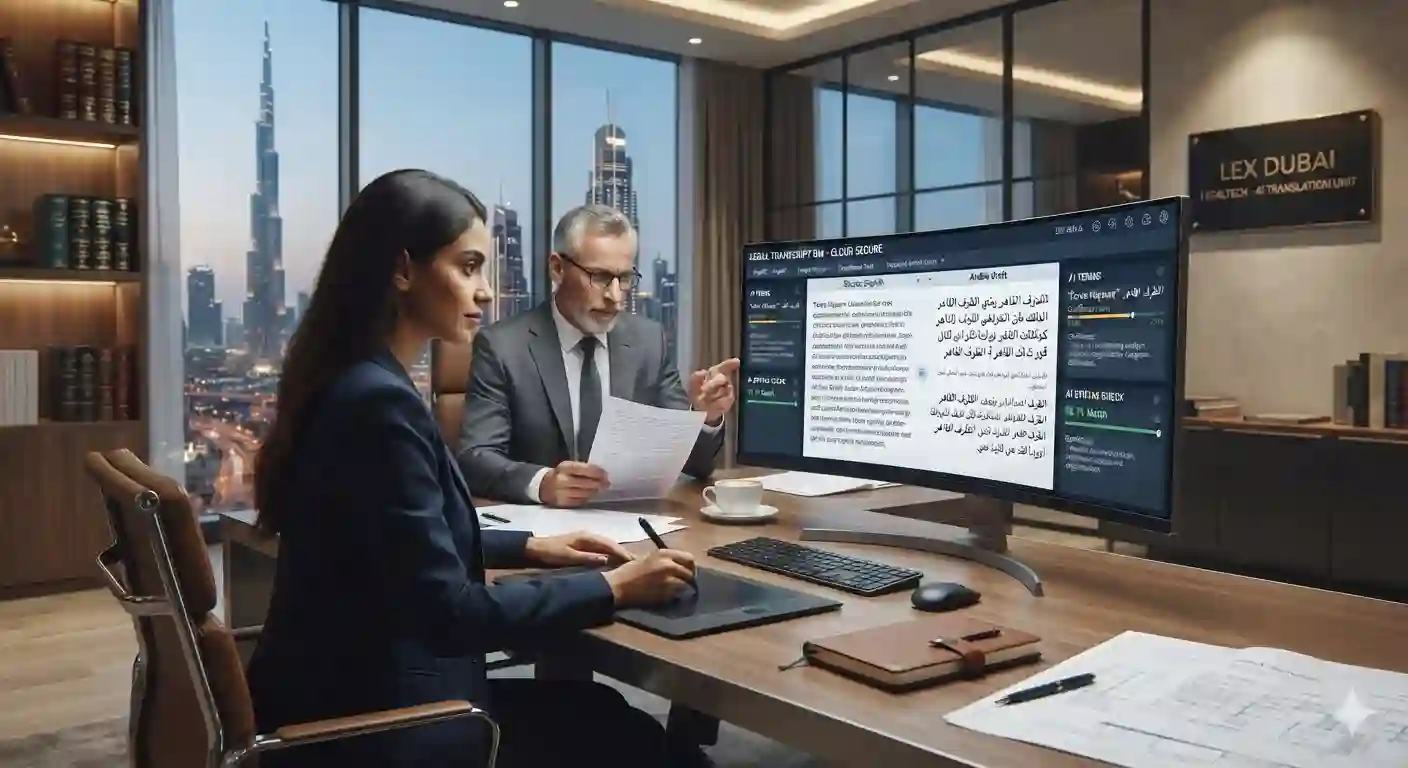
The future of certified legal translation services in Dubai will therefore probably not be about choosing between humans and technology. Instead, it will be about combining technology with qualified legal translators, strong quality-control procedures, confidentiality, terminology expertise, and an understanding of official requirements.
For Arabic-to-English and English-to-Arabic legal documents, this distinction is particularly important. Dar Al Bayan Legal Translation provides MOJ-certified legal translation for Arabic-to-English and English-to-Arabic documents. For other language combinations, Dar Al Bayan provides professional and official translation services, depending on the document and its intended use.
The UAE Ministry of Justice maintains services for registration and renewal of legal translators and publishes a translators directory, demonstrating that legal translation remains connected to a formal professional and regulatory framework.
So, what can businesses, law firms, investors, and individuals expect from legal translation in Dubai after 2026?
The Legal Translation Industry Is Moving Toward a Digital Future
One of the biggest changes will be the continued digitization of legal and government-related services.
Clients increasingly expect to communicate with service providers online, send documents electronically, receive quotations digitally, track projects, and receive completed documents without unnecessary physical visits.
The UAE Ministry of Justice already operates digital systems for legal professionals and provides online services across its justice ecosystem.
This broader digital environment is likely to influence translation companies as well.
Future legal translation workflows may increasingly include:
- Online document submission
- Digital quotations
- Electronic payment
- Automated document classification
- Digital project tracking
- Secure document delivery
- Electronic quality-control workflows
- Digital terminology management
- Integration with legal and business platforms
The result could be a faster and more convenient customer experience.
Artificial Intelligence Will Change Legal Translation — But Not Eliminate Human Expertise
Artificial intelligence is already transforming the translation industry.
AI-powered systems can process large volumes of text, identify terminology, compare documents, detect repeated phrases, and produce initial translations very quickly.
This creates opportunities for translation companies to improve productivity.
However, legal translation presents a different challenge.
A legal document may contain a sentence where changing one word can alter the meaning of an obligation.
Contracts can include:
- Rights
- Responsibilities
- Liabilities
- Conditions
- Exceptions
- Penalties
- Deadlines
- Definitions
- Jurisdiction clauses
- Dispute-resolution provisions
AI can assist with language processing, but professional legal translation still requires human judgment.
Recent research into AI literacy for legal translation similarly emphasizes that generative AI creates opportunities while introducing linguistic, legal, technical, ethical, and cognitive risks. The emerging direction is therefore responsible use of AI alongside professional competence rather than simply replacing legal translators.
Human Review Will Become More Important
Ironically, the growth of AI may make human review even more valuable.
As machine-generated translations become easier to produce, businesses may increasingly ask:
Who reviewed this translation?
Who is responsible for the final wording?
Is this translation suitable for official use?
Does it meet the requirements of the receiving authority?
For ordinary internal documents, an AI-assisted translation may sometimes be sufficient.
For legally significant documents, however, businesses may require professional review and, where applicable, certification by an appropriately registered legal translator.
This is particularly relevant to Arabic-English legal translation in the UAE.
Arabic-English Legal Translation Will Remain Highly Important
Arabic is central to the UAE’s legal and governmental environment, while English is extensively used in international business.
Dubai’s international business environment means companies regularly deal with documentation prepared in both languages.
This creates continuing demand for:
- Arabic to English legal translation
- English to Arabic legal translation
- Contract translation
- Court document translation
- Power of Attorney translation
- Corporate document translation
- Commercial agreement translation
- Legal correspondence translation
- Certificate translation
For applicable Arabic-to-English and English-to-Arabic legal documents, Dar Al Bayan provides MOJ-certified legal translation.
This specialized service will remain an important part of the legal translation market as Dubai continues to attract international businesses and investors.

AI-Assisted Translation Will Become More Common
The future translation office may look very different from the traditional translation office.
Instead of manually performing every stage of the translation process, professionals may use AI-assisted tools for selected tasks.
For example, AI can potentially help with:
Terminology Identification
The system can identify repeated legal and technical terms.
Document Comparison
AI can compare translated documents against previous versions.
Consistency Checks
Software can identify inconsistent terminology across long contracts.
Formatting Assistance
Technology can help maintain headings, tables, numbering, and document structures.
Initial Drafting
AI may assist with an initial translation that is subsequently reviewed by a qualified human translator.
The key word is assistance.
AI should not automatically be treated as a replacement for the professional responsible for a legally significant translation.
Confidentiality Will Become a Major Competitive Advantage
Legal documents often contain sensitive information.
A contract might include:
- Business terms
- Pricing
- Bank information
- Personal information
- Intellectual property
- Corporate structures
- Litigation information
- Commercial strategies
- Confidential agreements
As AI and cloud technologies become more common, clients will increasingly care about how their documents are handled.
Future translation companies will need to pay close attention to:
- Secure file transfer
- Access controls
- Data handling
- Confidentiality procedures
- Document retention
- Employee access
- Third-party technology providers
A translation provider that combines technology with strong confidentiality procedures can create greater trust with law firms and corporate clients.
Legal Translation Will Become More Specialized
Another major trend will be specialization.
The future legal translation market is unlikely to be dominated only by companies offering generic translation.
Clients may increasingly look for translators familiar with particular areas such as:
- Corporate law
- Construction
- Real estate
- Banking
- Employment
- Immigration
- Family matters
- Commercial contracts
- Intellectual property
- Litigation
- Arbitration
- Financial documentation
A construction company, for example, may want a translator who understands both legal terminology and construction terminology.
A financial institution may require someone familiar with banking and financial documents.
This means subject-matter expertise will become an increasingly important competitive advantage.
Law Firms Will Expect Faster Turnaround
Legal professionals often work under strict deadlines.
A lawyer may need a document translated before:
- A court filing
- A hearing
- A contract signing
- A transaction closing
- A government submission
- A corporate deadline
Technology can help translation companies respond faster.
However, speed cannot come at the expense of accuracy.
The future model is likely to be:
Technology for efficiency + human expertise for accuracy + professional procedures for reliability.
Digital Document Workflows Will Become Standard
Traditional translation workflows often involve:
- Sending documents by email
- Receiving a quotation
- Confirming the order
- Translating the document
- Reviewing it
- Delivering the final file
Future workflows may become more integrated.
A client could potentially:
- Upload the document securely.
- Select the language pair.
- Specify the intended use.
- Receive an automated quotation.
- Approve the project online.
- Track progress.
- Receive the completed document digitally.
- Request revisions through the same platform.
This could reduce administrative work and improve transparency.
The Role of Official Requirements Will Remain Important
Technology does not automatically determine whether a translation satisfies an official requirement.
The receiving authority, court, organization, or institution may have its own requirements.
Therefore, clients should continue to ask:
- Is certification required?
- Is a legal translator required?
- Which language is required?
- Is attestation required?
- Is a specific format required?
- Does the receiving organization have additional requirements?
The UAE Ministry of Justice provides dedicated services relating to legal-translator registration and renewal, reinforcing the importance of the professional and regulatory side of legal translation.
Businesses looking for information about registered legal translators and the applicable professional framework can consult the UAE Ministry of Justice’s legal translators resources.
Businesses should verify current requirements before submitting documents.
Certified Legal Translation Will Become More Trust-Based
As AI-generated content becomes easier to produce, trust may become one of the strongest differentiators in professional translation.
Clients may increasingly want to know:
Who translated my document?
Who reviewed it?
Is the translator professionally registered where required?
Can the provider explain the terminology?
Can the provider maintain confidentiality?
Can the provider help identify the appropriate translation service?
This creates an opportunity for established professional translation companies to demonstrate transparency and expertise.
What This Means for Arabic-English Legal Translation
For Dar Al Bayan, the strongest opportunity is specialized Arabic-English legal translation.
The company’s positioning should remain clear:
Arabic → English:
MOJ-certified legal translation for applicable legal documents.
English → Arabic:
MOJ-certified legal translation for applicable legal documents.
Other language combinations:
Professional or official translation, depending on the document and intended use.
This clear distinction helps customers understand exactly which services are appropriate for their documents.
Professional Translation for Other Languages Will Also Grow
Dubai is a multicultural international business center.
Companies may need documents translated into or from languages other than Arabic and English.
These requirements can include:
- Business documents
- Technical documents
- Marketing materials
- Corporate documents
- Educational documents
- Medical documents
- General documents
For these language combinations, Dar Al Bayan provides professional and official translation services according to the document and intended purpose.
The terminology used to describe the service should reflect the actual requirement rather than implying that every language pair falls under the same MOJ legal-translator framework.
Translation Companies Will Become Technology-Enabled Businesses
The traditional image of a translation office is changing.
A modern translation company may combine:
- Professional translators
- Legal specialists
- AI-assisted workflows
- Terminology databases
- Secure cloud systems
- Digital customer service
- Automated quality checks
- Online document management
This does not mean the human translator disappears.
Instead, the translator becomes more focused on high-value tasks such as:
- Legal interpretation
- Terminology decisions
- Contextual analysis
- Quality control
- Final review
- Client communication
Why Human Legal Translators Will Remain Important
Legal translation is fundamentally about meaning.
Consider a contract clause containing a condition, exception, or liability limitation.
A machine may produce grammatically correct text that appears convincing but does not accurately communicate the intended legal meaning.
Human translators can consider:
- Context
- Legal terminology
- Document purpose
- Jurisdiction
- Consistency
- Ambiguity
- Cultural and linguistic differences
This is why professional human review remains important for legally significant translations.
The Future of Legal Translation for Businesses
Businesses in Dubai will increasingly expect translation providers to operate like professional business partners rather than simply document translators.
A corporate client may want:
- Fast quotations
- Secure document handling
- Consistent terminology
- Reliable deadlines
- Professional communication
- Digital delivery
- Specialized expertise
- Clear information about certification requirements
Translation companies that provide this complete experience are likely to be better positioned for the future.
The Importance of Legal Translation for International Investors
Dubai continues to attract international businesses and investors.
International transactions can involve:
- Company formation documents
- Shareholder agreements
- Commercial contracts
- Property documents
- Powers of attorney
- Financial documentation
- Corporate resolutions
Some documents may need Arabic-English translation depending on their intended use.
This creates ongoing demand for professional legal translation services.
Businesses entering the UAE should determine their document requirements early rather than waiting until the final stage of a transaction.
What Clients Should Look for in a Legal Translation Provider After 2026
Choosing a translation provider will increasingly require more than comparing prices.
Clients should consider:
1. Appropriate Professional Status
For applicable Arabic-English and English-Arabic legal documents, verify the relevant legal-translator status.
2. Language Pair
Confirm that the provider handles the exact source and target languages required.
3. Legal Expertise
Ask whether the translator has experience with the type of legal document involved.
4. Confidentiality
Understand how sensitive documents are stored and handled.
5. Technology
Technology can improve efficiency, but it should support rather than undermine professional review.
6. Quality Control
Ask whether translations are reviewed before delivery.
7. Intended Use
Clearly explain whether the translation is for internal, commercial, government, court, or another official purpose.
Dar Al Bayan Legal Translation: Preparing for the Future
Dar Al Bayan Legal Translation is positioned to serve clients who need professional translation in Dubai while adapting to the changing digital environment.
For applicable legal documents involving Arabic and English, Dar Al Bayan provides MOJ-certified legal translation.
The company also provides professional and official translation services for other languages and document types.
Relevant services include:
for specialized technical documents.
Businesses requiring corporate documentation support can also explore:
and companies dealing with financial documentation may require:
For documents requiring additional formal processing, businesses can also explore:
What Will Not Change After 2026?
Technology will change how translations are produced.
But several fundamentals are likely to remain important:
Accuracy
Legal documents must communicate their intended meaning clearly.
Confidentiality
Sensitive documents require careful handling.
Professional responsibility
Clients need confidence in the person or organization handling their documents.
Legal terminology
Specialized legal language cannot always be treated like ordinary text.
Human judgment
Complex legal meaning requires contextual understanding.
Compliance with applicable requirements
Official submissions must follow the requirements of the relevant authority or organization.
The Future Is Human + Technology
The future of certified legal translation in Dubai is unlikely to be a simple battle between artificial intelligence and human translators.
Instead, the strongest model will combine the advantages of both.
AI can help with:
- Speed
- Terminology
- Repetitive tasks
- Document comparison
- Workflow automation
Human professionals can provide:
- Legal judgment
- Context
- Quality control
- Terminology decisions
- Confidentiality
- Professional accountability
Together, these capabilities can create a more efficient and reliable translation experience.
Conclusion
The future of certified legal translation services in Dubai after 2026 will be shaped by digital transformation, artificial intelligence, increasing international business activity, stronger expectations for speed, and continuing demand for professional legal expertise.
Technology will make translation workflows faster and more efficient, but legal translation will continue to require careful human oversight where accuracy, professional responsibility, and official requirements matter.
As Dubai continues to develop as an international business and legal hub, the future of translation will not simply be about translating more words faster. It will be about delivering accurate, secure, professionally handled, and appropriately certified documents through increasingly digital workflows.
Businesses that choose translation providers combining human expertise, technology, confidentiality, and a clear understanding of official requirements will be better prepared for the next stage of Dubai’s legal translation industry.
Frequently Asked Questions
What is the future of legal translation services in Dubai after 2026?
The industry is expected to become increasingly digital, with AI-assisted workflows, online document management, faster delivery, stronger terminology systems, and continued human review for legally significant documents.
Will AI replace legal translators in Dubai?
AI is likely to assist legal translators with repetitive and technical tasks, but human expertise remains important for legal context, quality control, terminology, confidentiality, and professional responsibility.
Does Dar Al Bayan provide MOJ-certified legal translation?
Yes. Dar Al Bayan provides MOJ-certified legal translation for applicable Arabic-to-English and English-to-Arabic legal documents.
Does Dar Al Bayan provide MOJ-certified translation for other languages?
For other language combinations, Dar Al Bayan provides professional or official translation services, depending on the document and intended use.
Will Arabic-English legal translation remain important?
Yes. Arabic and English continue to be important languages in UAE legal and business environments, creating ongoing demand for professional Arabic-English and English-Arabic legal translation.
Will legal translation become fully digital?
Translation workflows are likely to become increasingly digital, but official requirements and document-specific processes will continue to determine how particular translations are prepared and submitted.
Can AI translate legal contracts?
AI can assist with translation, terminology, comparison, and other tasks. However, legally significant documents should be reviewed appropriately by qualified professionals rather than relying solely on automated output.
Why is human review important?
Human reviewers can evaluate context, legal terminology, ambiguity, consistency, and the intended meaning of contractual or legal provisions.
What should businesses consider when choosing a translation company?
Businesses should consider language pair, document type, professional status where applicable, confidentiality, quality control, turnaround time, technology, and the requirements of the receiving organization.
How can I prepare for future legal translation requirements?
Identify the required language pair and intended use early, confirm the receiving organization’s requirements, and select a translation provider with appropriate expertise for the document.